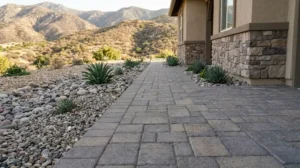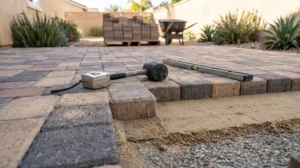
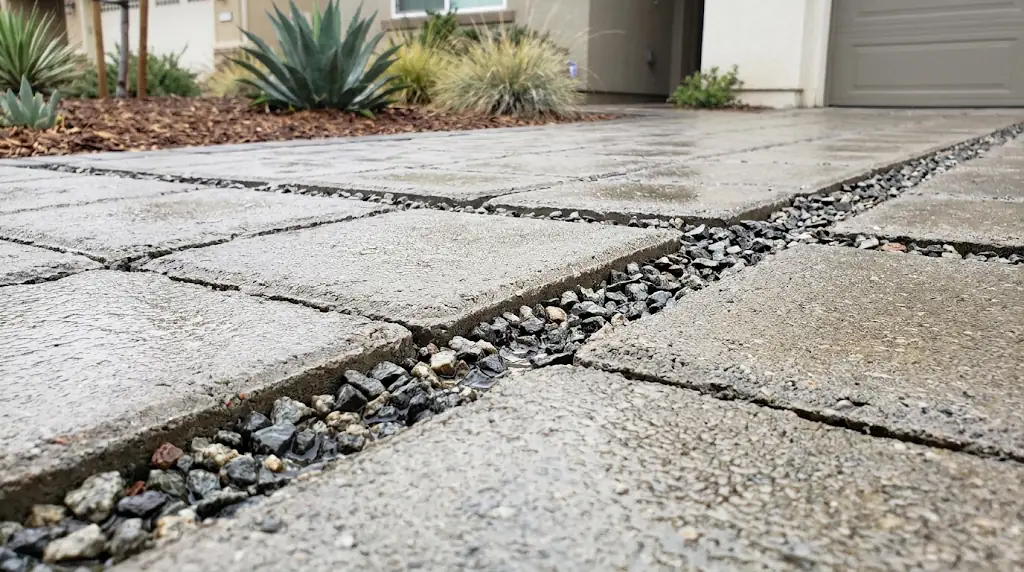
Permeable pavers help Inland Empire homeowners comply with local stormwater runoff rules by capturing 100% of surface precipitation on-site, filtering pollutants through aggregate layers, and directly recharging local groundwater basins. Instead of shedding high-velocity water into overburdened municipal storm drains, permeable systems eliminate off-site discharge and satisfy regional Low Impact Development (LID) and MS4 permit mandates enforced across San Bernardino and Riverside counties.
Working with Rancho Cucamonga Pavers allows property owners across Rancho Cucamonga, Ontario, Fontana, Upland, Chino Hills, and Eastvale to expand functional outdoor hardscaping without violating local impervious surface limits.
Inland Empire Stormwater Mandates and MS4 Permitting
Residential stormwater management in Western San Bernardino County and Western Riverside County is governed by the Santa Ana Regional Water Quality Control Board under National Pollutant Discharge Elimination System (NPDES) Municipal Separate Storm Sewer System (MS4) permits.
Municipalities must reduce urban runoff entering the Santa Ana River basin. When rain falls on non-porous surfaces—such as standard poured concrete driveways, asphalt pads, and solid roofs—it gathers motor oil, brake dust, fertilizers, and sediment. This contaminated water flows directly into city gutters, storm channels, and local water bodies without treatment.
Local development codes across Inland Empire cities enforce three primary mandates:
- Zero Net Runoff Increase: Hardscape additions or driveway widening projects cannot increase peak runoff volume or discharge velocity beyond the pre-existing state of the parcel.
- On-Site Retention and Infiltration: Cities mandate prioritizing Low Impact Development (LID) best management practices that capture, detain, and infiltrate stormwater on private property.
- Impervious Surface Ratios: Zoning codes in cities like Rancho Cucamonga and Ontario restrict maximum front-yard lot coverage, requiring that a designated percentage of property remains permeable to mitigate neighborhood flash flooding.
How Permeable Interlocking Concrete Pavement (PICP) Works
Standard paver systems rely on dense, compacted crushed road base and polymeric sand joints designed to shed water across the surface to an outer drain or landscape bed. Permeable Interlocking Concrete Pavement (PICP) functions as a complete subterranean water detention and filtration system.
The engineering profile consists of four open-graded layers:
| Structural Layer | Material Specification | Typical Thickness | Core Function |
| Surface Layer | Permeable Concrete Pavers | 2-3/8″ (Patios) to 3-1/8″ (Driveways) | High-strength concrete units with specialized joint spacer lugs |
| Joint Infill | ASTM No. 8 or No. 89 Crushed Stone | Fills paver joints | Replaces sand; allows water flow rates exceeding 100 inches per hour |
| Bedding Layer | ASTM No. 8 Angular Aggregate | 2 inches | Provides a level, open-graded setting bed free of sand fines |
| Base Reservoir | ASTM No. 57 Crushed Stone (1/2″ to 1″) | 4 inches | Choking transition layer providing 30% to 40% void space for water storage |
| Subbase Reservoir | ASTM No. 2 Open-Graded Stone (1-1/2″ to 3″) | 6 to 12+ inches | Heavy structural stone reservoir providing massive stormwater storage |
Rainwater hitting permeable pavers enters the stone-filled joints instantly. It filters down through the aggregate layers, which temporarily detain the surge in the stone voids before letting it percolate naturally into the native subgrade soil.
Permeable Pavers vs. Traditional Hardscapes for Stormwater Compliance
| Performance Parameter | Poured Solid Concrete | Standard Interlocking Pavers | Permeable Pavers (PICP) |
| Surface Infiltration Rate | 0% (Impervious) | 0% – 5% (Surface shedding) | 100+ inches per hour |
| City Lot Coverage Credit | 0% (Counts as hardscape) | 0% (Counts as hardscape) | Partial to full credit (City dependent) |
| Subsurface Water Storage | None (Requires yard drains) | None (Requires drainage swales) | High (Stone reservoir holds volume) |
| Runoff Velocity & Volume | High peak discharge to street | High peak discharge to street | Near zero surface runoff |
| Natural Pollutant Filtration | None | None | Traps hydrocarbons and suspended solids |
| Subgrade Soil Saturation Risk | Low (Water routed away) | Low (Water routed away) | Managed via geotextile liners or perforated drains |
City-Specific Code Applications in the Foothills and Valleys
Soil composition, municipal codes, and regional flood zones dictate how permeable systems must be constructed across the Western Inland Empire.
1. Rancho Cucamonga and Foothill Alluvial Zones
Properties situated north of Foothill Boulevard and along the base of the San Gabriel Mountains rest on coarse, rocky alluvial wash soils. These soils exhibit exceptionally high native percolation rates. In Rancho Cucamonga, permeable driveway systems take full advantage of this geology, using full infiltration designs that require no overflow pipes or sub-drains. Water drains straight through the stone base and recharges the local Cucamonga Valley groundwater basin.
2. Eastvale and Chino Hills Expansive Clays
South of the valley floor, Eastvale and Chino Hills feature heavy, high-plasticity clay soils with low natural infiltration rates (often less than 0.1 inches per hour). Discharging heavy volumes of stormwater directly into unmanaged clay causes soil heave, which can destabilize nearby building foundations.
For installations in these communities, an underdrained or partial infiltration design is required:
- A heavy-duty impermeable or semi-permeable geotextile liner isolates the stone reservoir from adjacent home foundations.
- Perforated PVC collector pipes are set into the bottom ASTM No. 2 stone layer.
- Water is captured, filtered, and slowly discharged into an on-site retention swale or dry well at a metered, non-destructive rate.
3. Ontario and Fontana Industrial and Residential Zones
Ontario and Fontana strictly monitor industrial and residential surface runoff to reduce sediment loads carried through municipal storm channels. Installing permeable pavers on private driveways allows homeowners to claim compliance credits with local storm management departments, simplifying approvals for front-yard renovations and driveway expansions that would otherwise exceed impervious square-footage caps.
Environmental and Structural Benefits Beyond Compliance
Meeting municipal regulations is only one component of the value proposition; permeable pavers deliver clear functional advantages:
- Eliminates Surface Puddling and Hydroplaning: Water drains immediately upon contact, preventing standing water, puddles, and moss growth across driveways, walkways, and patio areas.
- Preserves Surrounding Landscape Trees: Mature heritage trees common in Claremont and Upland require deep root hydration. Solid concrete slabs starve roots of oxygen and moisture, causing tree roots to heave upwards and crack pavements. Permeable pavers allow air and rainwater to reach subterranean tree root zones naturally.
- Lowers Ambient Summer Heat: The open voids within the gravel-filled joints and stone base promote air circulation and subsurface moisture evaporation, lowering radiant surface temperatures during extreme Inland Empire summers compared to solid asphalt or dark concrete.
Long-Term Maintenance Standards for High-Permeability Systems
To ensure continuous compliance with municipal drainage expectations, permeable interlocking concrete pavements require basic preventative care:
- Prevent Fine Sediment Contamination: Ensure adjacent garden beds and planter borders are properly edged or mulched. Prevent loose topsoil from washing directly onto the paver joints during heavy rain.
- Santa Ana Wind Debris Removal: Fine mineral dust deposited by autumn Santa Ana wind events can settle into the open-stone joints. Annual or semi-annual dry vacuum sweeping extracts fine dust particles before they consolidate.
- Aggregate Joint Replenishment: If high-pressure washing or suction displaces the ASTM No. 8 aggregate in the joints, re-sweep small crushed stone chips into the joints until flush with the paver chamfer edge. Never use fine sand or polymeric sand on a permeable paver system.
Build a Code-Compliant Hardscape System
Upgrading a driveway or patio with permeable pavers satisfies city stormwater management rules, expands usable front-yard space, and protects your property from water ponding and erosion.
To determine the right aggregate depth, verify your parcel’s soil infiltration rates, and receive a complete project estimate, visit our contact page to schedule an on-site consultation with Rancho Cucamonga Pavers.